Instance Segmentation for Underwater Laser Derived Point Clouds
We developed 3D instance segmentation system to analyze underwater laser derived point clouds.
Problem Statement
Maritime security increasingly depends on understanding submerged environments: inspecting infrastructure, detecting hazardous or suspicious objects, and monitoring ports or offshore assets. Sonar is robust and long-range, but it often lacks the spatial resolution needed for fine object-level inspection. Underwater laser scanning can provide dense 3D geometry, but the challenge is: how do we automatically interpret this data? A major bottleneck is that underwater data is expensive and difficult to collect. In many scans, there may be only one or two relevant objects. This makes training deep learning models unstable and reduces recall.
Method Overview
We benchmark transformer-decoder based instance segmentation methods on underwater laser derived point clouds. To address the object sparsity problem, we proposed a geometry-aware augmentation strategy: CAD-derived synthetic objects are inserted into real scenes, aligned to support surfaces, and checked for intersections so that the augmented scenes remain physically plausible.
Visual Results
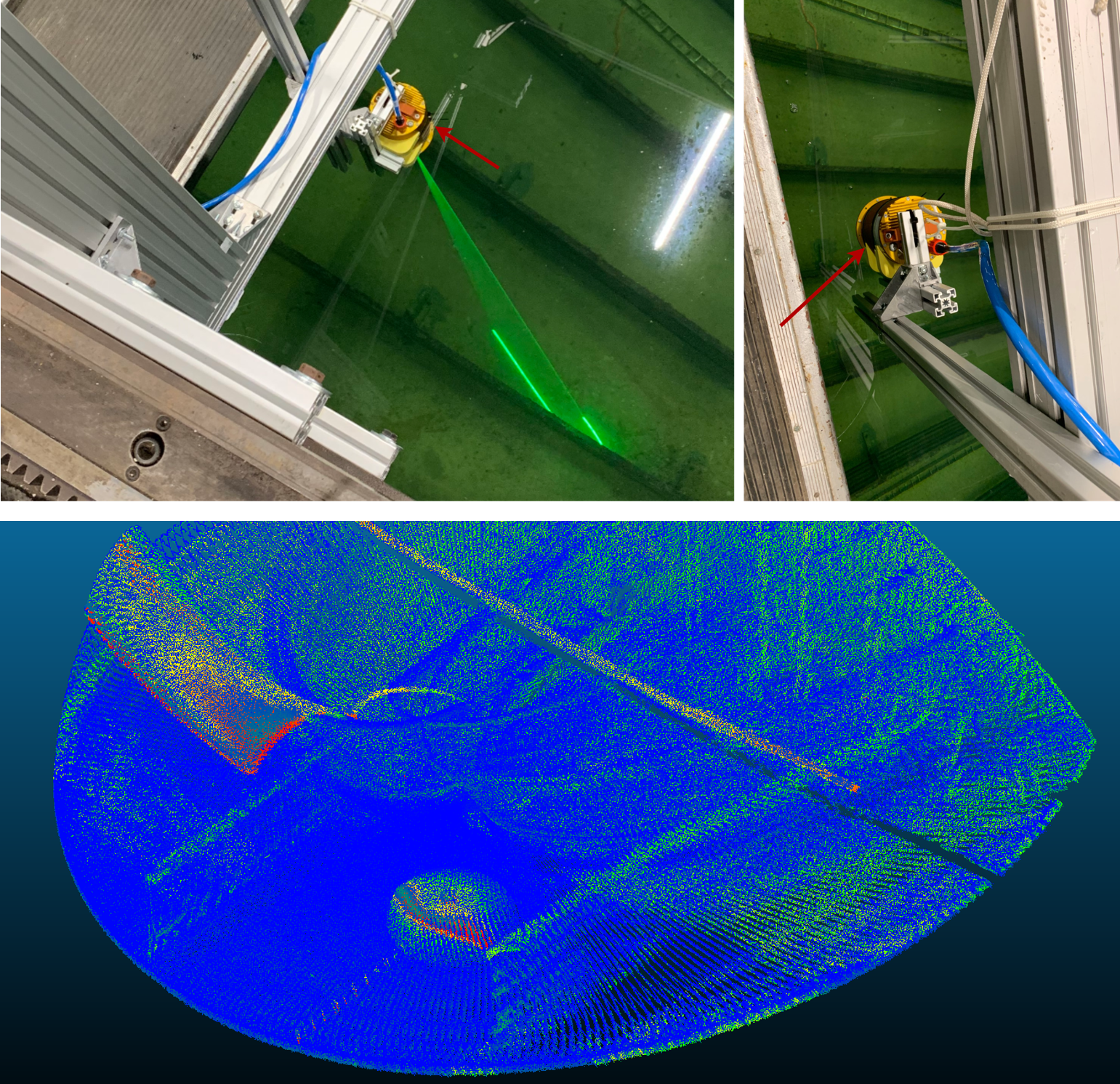
Sensor setup for underwater laser scanning in an indoor environment for prototype development.
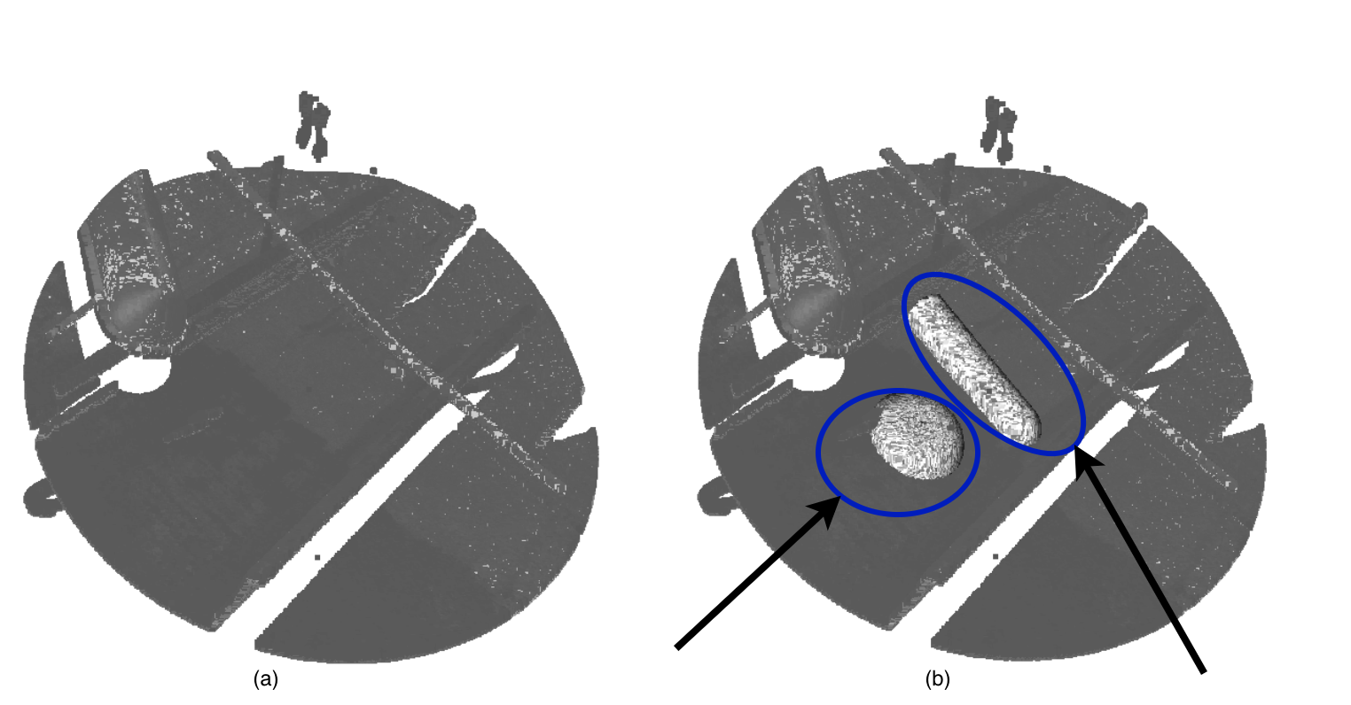
CAD-derived synthetic objects inserted into real scenes for data augmentation.
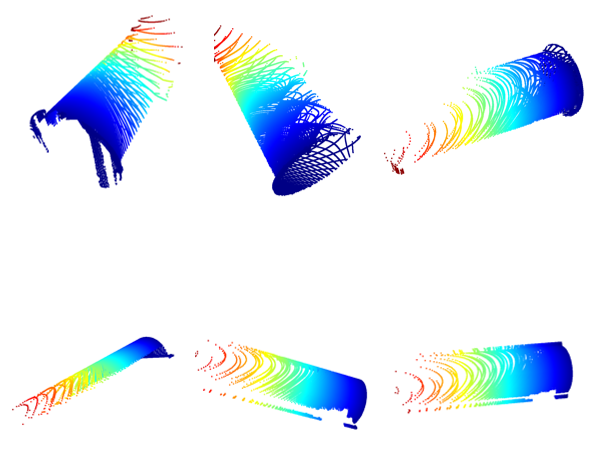
Simulated sensor to sample point clouds from CAD models as opposed to uniform sampling.
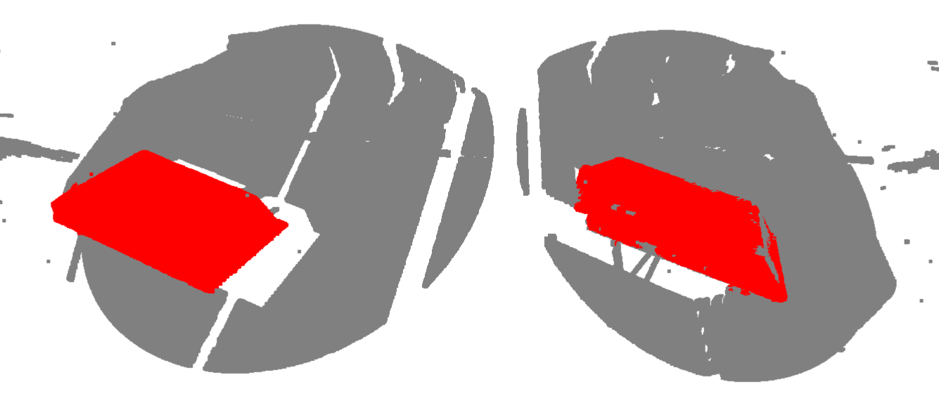
Results for 3D instance segmentation. Ground truth annotations are shown on the left and right respectively.
Quantitative Results - 3D Instance Segmentation
Average Precision (AP) metrics computed at various IoU thresholds. For the baselines, we report metrics that are evaluated with their official implementation.
| Method | AP25 | AP50 | AP | Prec50 | Recall50 |
|---|---|---|---|---|---|
| Oneformer3D | 42.36 | 18.21 | 6.21 | 40.75 | 32.92 |
| Oneformer3D-P | 55.19 | 28.24 | 10.80 | 61.11 | 55.24 |
| Mask3D | 35.20 | 20.67 | 17.91 | 51.32 | 38.45 |
Key Contributions
- Synthetic object insertion for data augmentation.
- Simulating sensor for point cloud sampling of synthetic objects.
- Feasibility study on application of modern algorithms on underwater laser scanning data.